Early this morning, I flopped onto my
sofa, flicked my television and satellite remotes and waited for something “newsy”
to appear.
That didn’t happen.
Instead, my television launched into some
kind of weird, complimentary-colored Pablo Picasso mode. The colors and abstract shapes shifted about the
screen in jerking fashion to the sounds of a normal audio feed.
I flipped through several channels and
found the same result.
On a different day, I might have
enjoyed this television mode.
After capturing the photograph I have
posted here, I rebooted and found some news.
In the bigger picture, perhaps we
might take comfort in the simple misery of knowing we all—man, fish, beast, and
bird—are little more than a compendium of dust particles swept across unfathomable
space. Time eventually smears all of us
into a singular, meaningless, impenetrable event. Who, then, in a half-billion years, will
recall the sad tale of Nigel the gannet?
Nigel lived his last five years on the
small, otherwise uninhabited island of Mana, just off the coast of mainland New
Zealand. The “otherwise uninhabited”
part of this story is a bit tricky.
Years ago, conservation rangers from New Zealand placed some eighty immobile,
painted concrete replicas of gannets on the eastern cliffs of the island. The same rangers also broadcast gannet calls
from speakers powered by a small solar photovoltaic system. The hope was to attract nesting gannets back
to the island after forty years of absence.
Nigel landed on the island in 2013 and
soon began courting a particular concrete bird.
Who can say why that bird?
Something about the curve of her sleek neck? Her colors a bit brighter? A certain flaw that made her seem approachable
for a regular bird like Nigel?
Nigel made his choice and did not look
back again. He lived alone with his
concrete love and her inanimate concrete companions.
Nigel groomed her concrete flanks, her
cold neck. He carefully constructed a
nest for her. For five years, devoted
his time to his concrete mate.
Recently, Nigel was found dead
alongside the cold mate he chose. He had
never wavered in his dedication to her.
Of course, to be a true tale of
sadness, there must be one more insult to add to injury. In the story of Nigel the gannet it is
this: Nigel died only a few weeks after another
three living gannets settled into another part of the concrete colony alongside
him.
Nigel ignored the other living
gannets, of course. His love for his concrete
mate remained steadfast until the end, until he was swept against the great
unknown.
-- Mitchell
Hegman
The details of
this story are from an article that appeared in The Guardian.
Perhaps, you played that game as a kid—you
know—where you try to see who can stare the longest without blinking. Maybe you and a friend stared directly at
each other. You stared until your eyes
watered. You stared until your vison
went out-of-focus.
But eventually someone gave in.
After the first person blinked,
everyone happily blinked. And blinking
your eyes felt better than anything else in the world.
The blink reset everything.
While in Aruba, it occurred to me that
I need to blink—in terms of producing a daily blog, I mean. I need to stop forcing daily blogs. I may need to allow days to pass without a
blog. For one thing, I feel my blogs
have been suffering from serving quantity rather than quality in their
measure. In recent weeks, I have been
very frustrated by an increasing occurrence of repeating themes, spelling
errors, typos, etc.
I will not stop blogging. I enjoy it!
My goal is to provide a well-rested blog with more horsepower.
One of my intentions is to (as I have
done in recent months) devote more time to other writing projects. The first project is a technical book in
digital multimeters. The other us a
telling of my late wife’s life, which is hugely beautiful and tragic at the
same time. I have many dozens of pages
started on each of these projects.
I am at a loss for words on what I need
to say next. I know what I want to say, but
nobody has yet invented words big enough, bright enough, and strong enough to
convey everything. So here goes: My sincerest thanks to all you who have
stopped by to see me daily at the blog. Having
you out there has been both humbling and gratifying for me.
-- Mitchell
Hegman
Note: Later today
I will finally be arriving back home in beautiful Montana!
The California Lighthouse sits on the
northernmost end of Aruba. Immediately
below the lighthouse is Faro Blanco Restaurant.
Last night, we enjoyed a sunset dinner at the restaurant as a way to
close out our last full day on the island.
Faro Blanco Restaurant is mostly an
open terrace providing an expansive view of the ocean and the setting sun. The establishment also features a small bar with
a very gregarious bartender. According
to information provided on the menu, the restaurant started life as a dwelling
for the lighthouse keeper.
The California Lighthouse stands 100
feet tall, is 25 feet in diameter, and is made from stone blocks. Lighthouse construction was completed in
1916. The lighthouse (and the northernmost
point of the island) is named for a vessel that shipwrecked off the coast of
Aruba not far from where the lighthouse now stands.
The S.S. California was a wooden steamship. She ran aground at midnight on September 23,
1891 on her way from Liverpool to Central America. According to all accounts, the passengers
were having a pretty big party onboard when the vessel wrecked. As the ship came apart on the shores of the
island, the crew pitched cargo overboard so it might be salvaged and sold in the
city of Oranjestad on the island.
All of us greatly enjoyed our meals at
the restaurant, while only slightly annoying the people sitting near us.
Sunset was spectacular.
Each of made some
horrendous attempts at pronouncing what we wanted from the menu (the waiter
loved that). And my hair was the worst
it been because the wind was working me from the wrong direction (Bill loved that).
When we left the restaurant after our dinner,
we found the moon and the lighthouse side by side against the cobalt sky.
If you thumb through just about any tourist
literature from Aruba, you are bound to see an image of at least one of the two
beachside trees at the uppermost end of Eagle Beach. We have seen the trees a couple times on or
treks along the coast. Yesterday, we
drove to Eagle Beach with the express idea of capturing our own photographs of
the iconic trees.
Morning has perfected itself in
Aruba. Nothing should ever change about
sunrise and the first hour thereafter on this island. The temperature is perfect. You can step outside in whatever fashion you
have risen from your bed.
The sun begins soft and small as a
marshmallow before expanding and rising up into a golden sky. Then, across the elevated neighborhoods,
roosters call from yellow stucco houses with red tile roofs and from pink stucco
houses with green tile roofs. Songbirds,
whose faces and names I don’t know, answer the domestic birds in elaborate, fluting
songs while perched atop stucco fences and tall cactus stands gently swaying in
the never ending trade wind.
And often, in the first hour, puffy
clouds that have spent the whole of night lazing just off shore, extend white
arms and flushed fingers to the center of the island, delivering brief,
glittering sun-showers just like the ones I love to watch as they fall cross
the open prairies of Montana.
All this before most of the island
begins to stir, before small craft stretch their whitewater tails across the
sheltered aquamarine seawaters.
Last night, I woke to my last cold sweat and knew the flu was
losing its hold on me. This morning, I
feel much better. Today, I am posting
what I intended to post several days ago.
The day my illness first struck me, we
rented side-by-sides and toured the undeveloped north shore of Aruba. This is the windward side of the island. Big waves curl against the mostly rocky
shores. Vegetation is sparse.
The side-by-side tour was interesting,
if not something of a free-for-all. A
dusty one at that. At the beginning of
our tour the lead guide suggested the first stretch was something of a test of
our skills. He urged everyone to “keep
up.”
And off we roared. Over rocky terrain. Through stands of cactus. Up hills. Down hills. Bouncing.
Sliding around corners.
I’m talking Baja 500 stuff here. But with regular, everyday people behind the
wheels instead of drivers who know what to expect.
I quickly realized the neck scarfs
they gave us at the rental shop were necessary.
We were creating our own raging dust storm!
And we beat the hell out our machines
to keep up. Larry and Chris ended up with
a broken tie-rod and had to take a machine from one of our guides. Patrick and Mary got a flat tire, which was repaired
on the spot.
At the turn-around point of the tour,
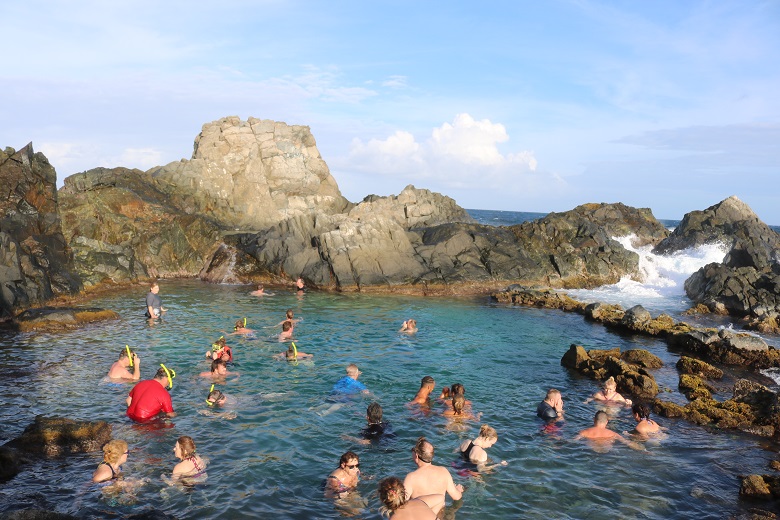
we bounced straight down a rocky outcrop to reach “Conchi.” Conchi, also known as “Natural Pool,” is a
pool protected from the high crashing waves by a natural rim of rocks that
disperse the waves allowing only tamed, white, bubbling inflows of water to
drain into the pool.
On the way back to our machines after swimming
in Natural Pool, Larry borrowed a string of fish from a local spear fisherman so I
could take his picture. As he said: “How
often am I gonna get a chance to pose with a string of barracuda?”