Photography And Half-Thoughts By Mitchell Hegman

...because some of it is pretty and some of it is not.
Showing posts with label Rocks. Show all posts

Thursday, August 6, 2026

Conglomerate

Conglomerate is the natural geological presentation of concrete. Long before we figured out how to mix cement with gravel, nature was doing much the same thing. Rivers rounded stones into smooth pebbles, layers of sediment buried them, and mineral-rich groundwater slowly cemented everything together into solid rock. The process took thousands to millions of years rather than an afternoon with a concrete truck and an ample supply of beer, but the result is surprisingly familiar.

One of the first "keeper" rocks in my collection is a time-worn conglomerate specimen I collected no more than 100 yards from the spot where my house presently stands.

I was 6 or 7 years old the day I found this treasure. Honestly, it still ranks as one of the most thrilling finds of my life. I gasped when I first spotted the rock amid a few nondescript stones. It was a perfect representation of nature's concrete and an ancient story told in stone.

"Look at this!" I said after trotting back to find my father and show him my discovery.

Though I proved a disappointment to my father when I revealed a propensity to pick up random stones rather than a baseball, he did his best to share my enthusiasm.

The conglomerate specimen has been on display on a shelf somewhere near me ever since. Every time I pick up the stone, I feel a certain earthy energy in the weight of it. It is of immeasurable value to me.

The photograph below is that very rock.

Conglomerate Specimen

—Mitchell Hegman

Friday, July 17, 2026

The Sapphire Thing

Montana is America's sapphire state, home to the nation's only major deposits of gem-quality sapphires. Most are found in four classic localities: Yogo Gulch, Rock Creek, Dry Cottonwood Creek, and the Missouri River gravels northeast of Helena. The Missouri River deposits quite literally extend through the property on which I constructed my house. Given my feral obsession with rocks and my proximity to precious gems, I am regularly compelled to purchase bags of sapphire pay gravel from one or another of the nearby mining operations so I can glean a few stones.

Just yesterday, we poked through a bag of gravel processed from the Spokane Bar Sapphire Mine.

Good stuff.

We found several larger sapphires I like to think of as "tink-tinks" because of the distinctive sound they make when dropped into a holding bottle. Most of the gems ranged from green to blue. The largest, though not of perfect quality, I would estimate to be around 4 carats. I'm sharing a photograph of the gems we found.

Looking for Sapphires

Our Precious Finds

—Mitchell Hegman

Thursday, May 21, 2026

Next Level Rock Collecting

I’ve taken my rock collecting to the next level.

After shopping at a local box store, a sparkly rock among the washed stones in a parking lot island beneath a streetlight caught my eye. Next thing you know, I’m full-on mining for precious goodies right there in the parking lot without a permit.

I mean, I filled my hands with glittery specimens.

The rocks appear to be infused with mica. If tipped at certain angles against the light, these stones positively flash.

Thing is, good rocks are where you find them.

Glittery Parking Lot Rock

—Mitchell Hegman

Monday, April 20, 2026

Splitting a Geode

If you are any kind of rockhound, you cannot miss a “rock show.” Yesterday, to maintain our rockhound status, Desiree, my sister Deb, and I took time to check out the annual Helena Mineral Society Gem and Mineral Show.

Among all the vendors of fossils, gems, cut stones, and unique mineral specimens, we found a guy selling loads of geodes. Geodes are nature’s little treasure chests—plain on the outside, wholly extravagant within. When you split one open, it feels like the earth hid a galaxy in a rock, then chucked it off to the side.

Making the geode experience far more interesting was the fact that you picked your own whole stone and then cracked it open yourself using a chain that applied great pressure when you turned a ship’s helm wheel, all of which was mounted on an old wooden barrel.

The geodes were formed first as a bubble of gas trapped in cooling lava, leaving a hollow behind as the volcano released its heat. Then, over long stretches of time, mineral-rich water seeped into that cavity, and through crystallization, layers of quartz slowly formed along the inner walls.

After watching a couple of other people crack open geodes, Desiree purchased one and took a turn at the wheel. As the vendor held the stone in position, she cranked down the pressure until the geode popped into two.

Ta-da! Each half bloomed with a dazzling array of crystals.

The Rock Show Floor as Seen from the Mezzanine

Desiree Splitting a Geode

Inside the Geode

—Mitchell Hegman

Tuesday, April 14, 2026

The Sapphire Bucket

One look inside my garage will tell you I’m a fan of 5-gallon buckets. On my last count, I had 17 of them in some form of use. Still, none of them quite compare to the “sapphire bucket” I received as a birthday gift.

This one-of-a-kind, customized bucket was fashioned by fellow rockhound Tad St. Clair. It serves as a complete kit for gleaning sapphires from pay gravel gathered from deposits along the Missouri River near my house, a simple idea turned elegant.

The kit includes a clear glass plate that rests on the rim of the bucket, a battery-powered LED light glowing up from within, and a small plastic container with tweezers and compartments for the safekeeping of any promising finds. Gravel is spread across the glass, and with a little patience and a careful eye, the light reveals what the river has chosen to keep hidden.

Tad also included a small bag of pay gravel from a trip we made to the local gem and mineral society dig near Lakeside. I am posting photographs of the bucket and of Desiree making a run with a handful of pay. No sapphires surfaced this time, but that feels beside the point. We will gather more gravel soon and let the light try again.

The Sapphire Bucket Complete

The Kit on Display

Desiree Looking for Sapphires

—Mitchell Hegman

Thursday, November 27, 2025

The Surprise Rock

I have a serious thing for rocks. I mean, let’s do the math on this. I have dedicated two display shelves in my den for displaying rock specimens. I go to gem and mineral shows for fun. One of my blog categories is literally titled “Rocks.” If I’m out walking, I’m looking for rocks at the same time. Honestly, I suspect I like rocks better than the proverbial “next guy,” unless the next guy is a geologist who licks them to identify minerals.

All that considered, there are moments when I am not seeking rocks and would prefer they stay hidden—digging a hole to plant a tree, for example. And yesterday, while scooping out a handful of what was supposed to be garden soil from a 1½-cubic-foot bag we bought a few weeks ago, I fished out a rock nearly big enough to qualify as a boulder. Nothing pretty. Just a plain, garden-variety lump and exactly what you don’t want in your garden soil.

To be fair, calling the stuff big-box stores bag up and sell as garden soil is something of a stretch. Typically, what you get is a bunch of small sticks from a big-city compost pile, some of which are mashed up pretty well.

But on this one, I think someone owes me my rightful handful of sticks.

I’ve posted a photograph of the rock posed with a Cold Smoke beer as a righteous reference to size.

The Rock

—Mitchell Hegman

Monday, November 24, 2025

Embraced

While wandering about on the indigenous fringes of my property, I found Romeo and Juliet.

A quick synopsis of their tragedy: two young lovers from feuding families fall into a secret, desperate romance. Knowing they would not be allowed to embrace in life, they instead embrace in death.

In my local scrubland version of this tale, Romeo is a juniper and Juliet is a rock. Romeo died some years ago and was upended by the elements, exposing his tangle of roots. And this is where you find our Juliet, a smooth-sided rock Romeo gathered gently into his roots when he was young. Even all these years after death, Romeo still holds Juliet close.

I’m sharing a photograph of my Romeo and Juliet.

The Embrace

—Mitchell Hegman

Friday, October 24, 2025

The Good Fortune of a Gully Washer

A literal “gully washer” rainstorm swept through the ranchlands late this summer. The heavy runoff waters gouged down all the slopes and thrashed through the gully bottoms, removing and dragging off the accumulations of pine needles and pine cones. In some places, the water scrubbed away thin layers of overburden and exposed an underlayment of rocks.

This occurred in some of my prime rock-hunting ground.

Yesterday, I took a hike through some of the rumpled land and bloodhounded down through the deepest gully bottoms, looking for rocks. I quickly filled my pockets with shale, quartz, and specimens of multicolored jasper. But the most interesting and unusual rock is a weathered chip of limestone.

The bottom is gray and smooth as an eggshell. The top is white and looks like a skyrise city in miniature. What makes this more fascinating is the fact that my neighbor, Kevin, collected a smaller piece similar to this many years ago.

Top View

Bottom View

Side View

—Mitchell Hegman
Tuesday, September 16, 2025

Jefferson River Rocks

Desiree and I have been staying in Three Forks for the past two nights. Yesterday, just for fun, we stopped at a Jefferson River fishing access to see the water up close. Named by Lewis and Clark in 1805 for President Thomas Jefferson, the river joins the Madison and Gallatin here to give birth to the Missouri. At that spot it stretched calmly over a wide bed of stones and pebbles, sweeping bare alluvial shoulders at most bends. Naturally, our stop turned into a rock-hunting expedition along the water’s edge. As I plodded across the stony flats, I picked up only three small, river-polished stones. Still, in my way of thinking, three Jefferson River rocks are far better than none.

The Jefferson River

Jefferson River Rocks

—Mitchell Hegman

Saturday, July 5, 2025

Space Rock?

On second thought, I took a step backward.

While walking the road down to the lakefront, I had stepped over an oddly colored rock in the graveled rut. After stepping back up the hill, I scooped up the rock and found it astoundingly weighty. Moreover, the rock had the look of iron.

When I showed the rock to some folks gathered at the lake to celebrate Independence Day, several people wondered if it might be a meteorite. A later experiment proved the rock highly attracted to a magnet.

Once home again, I scoured the internet for information about the rock. Two possibilities emerged: meteorite or limonite.

While a meteorite is space stuff, limonite is a common, earthy iron ore made up mostly of hydrated iron oxides and other iron-bearing minerals. It forms in a variety of low-temperature, near-surface environments as part of the weathering and oxidation of iron-bearing minerals. Limonite is often found in river and lake sediments (especially oxidized gravels), which exactly fits the bill for the virtual pile of rocks upon which my road traverses.

I’m leaning toward limonite on this one.

My Heavy Rock

A Magnet Stuck to the Rock

—Mitchell Hegman


Sunday, April 13, 2025

Jasper

Jasper is an opaque, microcrystalline variety of quartz—specifically, chalcedony—that’s often richly colored due to the presence of various mineral impurities. It comes in virtually every color, but red, brown, yellow, and green are the most common. Some varieties, like picture jasper, feature striking banded, orbicular, or scenic patterns.

Jasper forms when silica-rich solutions—often from volcanic ash or sediment—seep into cracks and pockets in the Earth’s crust. These solutions carry along a whole cocktail of minerals that contribute to the wild variety of hues and markings. Over thousands, even millions, of years, these silica solutions harden into microcrystalline quartz—layer by layer, pattern by pattern. The result is jasper: stone born from slow-moving water and fire.

And it’s everywhere. Jasper is not rare—it can be found on nearly every continent. From the windswept coasts of Madagascar to the convulsing mountains of Montana, it shows up in all its regional variations. In addition to being blessed with striking colors, jasper takes and holds a polish remarkably well.

Yesterday, on my annual visit to the Helena Mineral Society’s Gem, Mineral, and Fossil Show, I felt compelled to buy four specimens of jasper. Two are from Madagascar, one was fished from Montana’s Blackfoot River, and one is of unknown origin. No matter. All are lovely. I am sharing a photo of the stones here today.

Jasper

—Mitchell Hegman

Saturday, February 1, 2025

The Rock Collector

Apparently, the passenger-side rear tire on my car enjoys collecting rocks just as much as I do. It has collected two rocks in the last six months, requiring me to have the tire repaired each time.

Interestingly, my tire has wholly different criteria than I do for choosing which rocks it collects. The tire goes for sharply edged, rather plain-looking specimens. I, on the other hand, am drawn to more colorful rocks, especially those rounded and polished by the forces of nature. Just the same, I have added the specimens collected by my tire to my own rock collection.

I’m sharing a photograph featuring the two rocks picked up by my tire, along with a can of Cold Smoke beer as a reference for size. The specimen on the right is the most recent.

My Tire’s Rock Collection

—Mitchell Hegman

Saturday, December 28, 2024

Seeking Precious Stones, Part II

Welp, I guess it’s back to the proverbial poorhouse for me and Desiree. We spent another shift in the sunroom winnowing through the last of the sapphire pay. We found only a few baby gems, some of which might even qualify in the “spec” category.

No big, showy stone for us.

I’m mildly disappointed, but I always feel a specific satisfaction in finding sapphires of any size. We’re talking sapphires in dirt—how bad can that be?

I’ve posted a photograph of the last batch of gems we picked from the gravel, along with another photo of the entire collection alongside a Cold Smoke beer for a more accurate size reference.

The Final Batch of Sapphires

Sapphires and Cold Smoke

—Mitchell Hegman

Friday, December 27, 2024

Seeking Precious Stones

Yesterday evening, we set up shop in the sunroom and began processing the sapphire pay I gave Desiree for Christmas. We are seeking a sapphire of sufficient size and clarity to have it cut for a ring. We would love one in either blue or pink but would be delighted with any color, provided the stone is big enough to facet.

Both Desiree and I enjoy “hunting” for sapphires in the comfort of our own home, a glass of wine by our sides. Last night, we winnowed through about half the material. We found many small specimens and one large one. The large sapphire was, unfortunately, deeply flawed and of no value to us. We will likely take another run at the gravel tonight.

One day, maybe tonight, our sapphire is going to find us.

Our Finds from the First Night

Desiree Looking Through the Gravel

—Mitchell Hegman

Thursday, December 26, 2024

A Sack of Dirt

Finding the ideal gift for your spouse at Christmas can be challenging. This year, however, I think I outdid myself in this endeavor.

I gave Desiree a sack of dirt.

The perfect gift.

Of course, this wasn’t just ordinary dirt. The stuff I gave her was paydirt—gravel, really—from one of our local sapphire mines. I keep telling Desiree that one day we’re going to find our own big, flawless sapphire and have it custom-faceted and set in a worthy piece of jewelry. We’ve sifted through several other such sacks in the past but haven’t found exactly what we’re looking for.

Maybe this is the one.

Desiree’s Sack of Sapphire Gravel

—Mitchell Hegman

Saturday, November 2, 2024

Boulders from the Batholith

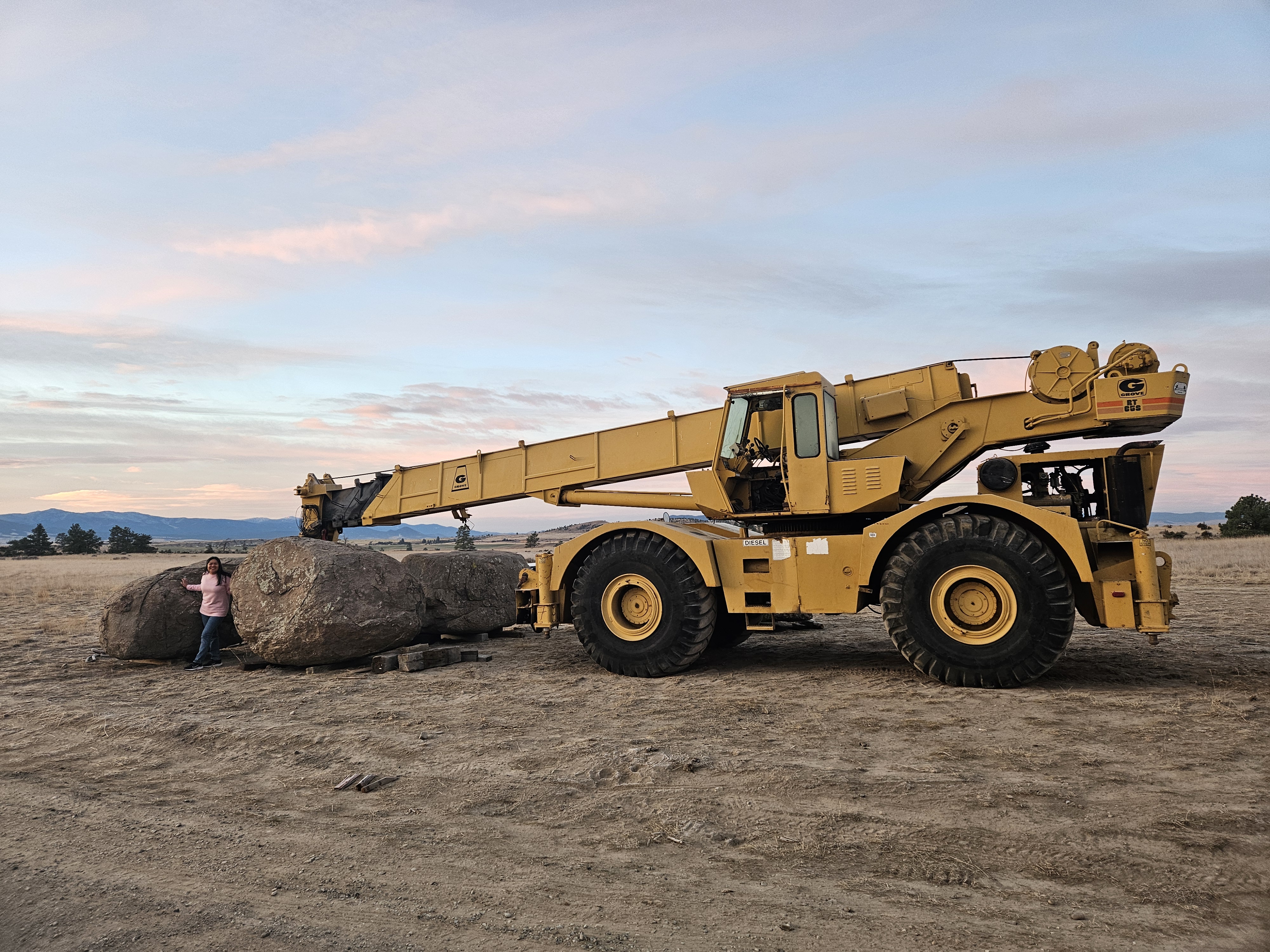
My neighbor has what you would term a large disposable income. I have a modest disposable income. While I can purchase a few pretty, fist-sized rocks at the gem show and lug them home in a plastic bag, he can buy multi-ton boulders, have them shipped in on oversized rigs, and then set them strategically about his property with a crane.

He is actually doing so as I write this.

The boulders in question rolled in (the huge trucks rumbling, I might add) from the granite formations within the Boulder Batholith amid the Elkhorn Mountains. The boulders are impressive, some approaching the size of a small automobile. Given that granite weighs 165 pounds per cubic foot, I’m thinking most of these monsters weigh somewhere north of 30,000 pounds. And, me being me, I love rocks of any size, so I approve.

I am posting a series of images of the boulders, including one featuring a crew setting one at the fork of the road in front of our house and two with Desiree (instead of a Cold Smoke beer) near more boulders as a reference for size.

Setting a Boulder at the Fork in the Road in Front of my House

Final Placement (With My House in the Background)

More Boulders Near the Crane

A Boulder Set Where Our Spur Originates at the Main Road 

—Mitchell Hegman

Sunday, October 27, 2024

A Rock on a Post

Some things make sense on the surface—they are instinctive, and you don’t need to dive deeply to know it’s the right thing to do. A perfect example of this is opening the door for someone who is carrying something. It’s an automatic human response.

Another action that falls into this category is placing a rock on top of a post when you come across one in the middle of nowhere. It just makes sense to find a rock and place it on top of the post—no need for explanation.

Yesterday, I passed by a lone fence post that had been recently pounded into the ground at the edge of what we call Big Tire Gulch. I immediately noticed that someone had placed a smooth, roundish rock on top. This pleased me so much that I stopped and captured a photograph. Had someone else not done so, I would have felt compelled to find a rock for the post myself.

A Rock on a Post

—Mitchell Hegman

Friday, August 30, 2024

Practical Rocks

I have an extensive rock collection—we’re talking two 6-foot-tall bookshelves filled with specimens, and more. Most of the rocks in my collection are there because I find them pretty or unusual in some manner. A few specimens may be of genuine value, but I don’t necessarily appreciate those any more than the others.

Over the years, however, a handful of rocks have achieved the status of “practical” in my life. For example, on occasion, a rock from the collection assumes the not-so-glamorous role of acting as a paperweight. But others have taken on more critical jobs. Below are three photographs of my practical rocks along with their purposes:

The Rock We Use for Scrubbing Ourselves in the Shower

Rocks for Holding Cedar Planks Submerged in Water While Soaking Them for Use When Grilling Salmon

A Door Holder

—Mitchell Hegman

Friday, July 26, 2024

A Rock of Known Value

Generally speaking, I think I love rocks more than the next guy. I started collecting rocks as soon as I could clutch my hands, and I have been collecting ever since. Just yesterday, I picked up a thirty-dollar rock. Well, technically, the tire of my car picked up the rock.

For a rock to be properly and permanently collected by the tire of your car, it needs to fully penetrate the tire, which this rock did. In piercing the tire, the rock began a slow process of deflating the tire in question. Fortunately, I made it to the nearest tire shop before the tire went entirely flat. Thirty dollars later, I left with a repaired tire and a rock in my hand. Though the rock is neither pretty nor unique, I will be adding it to my collection as a matter of principle.

My Thirty-Dollar Rock

Proof of Value


—Mitchell Hegman

Tuesday, July 16, 2024

Lewis and Clark Caverns

Found within Montana's first state park, established in 1937, and located along the Jefferson River within the Tobacco Root Mountains, Lewis and Clark Caverns offers a glimpse into the state's subterranean marvels. Even given its depth inside the mountains, a tour of the caverns will, at one point, find you at an elevation of exactly one mile above sea level.

The geological formation of the caverns is a result of ancient sea deposits dating back to the Mississippian period, around 325 million years ago. Today, the caverns showcase a variety of spectacular formations, including stalactites, stalagmites, and columns, each requiring centuries of slow, patient development. All of the formations are the result of slightly acidic water dissolving minerals from the limestone, then dripping into the caverns and leaving behind deposits of calcium carbonate. These deposits build up over the eons to create all the wondrous features seen today inside the cave system.

Yesterday, Desiree and I took a 2-hour walking tour of the caverns. The tour proved both beautiful and pleasurable given the cool temperature of 50°F inside the caverns. I am posting photographs from our tour.

Waterfall Formation

Grand Finale Room

Desiree in the Caverns

Our Tour Group Descending

—Mitchell Hegman